

Once foundational prerequisites are in place, unstructured data management becomes a question of capability, not tooling. This is the inflection point organisations reach when scale exposes the limits of tool-based approaches.
The DCIG 7 Pillars of Unstructured Data Management framework identifies four core capabilities required consistently across organisations, regardless of industry. These are not optional enhancements. They are the baseline requirements for managing unstructured data as it grows in scale, diversity, and importance.
And integration is essential. What matters is not whether an organisation has tools in each area, but whether these capabilities operate together, across the data lifecycle. In practice, this integration is where most approaches fail, not because the capabilities are unknown, but because they are implemented in isolation.
1) Data collection and ingestion
Every downstream decision depends on how data enters the system.
Ingestion is not simply a transfer. It is the moment where metadata is either captured or lost. Provenance, relationships, timestamps, and meaning must be preserved early because they are often impossible to reconstruct later. At scale, failures tend to cascade; missing context at ingestion quietly undermines governance, security, and reuse downstream.
At scale, effective ingestion requires:
Support for diverse sources and protocols
Early metadata capture
Classification that travels with the data
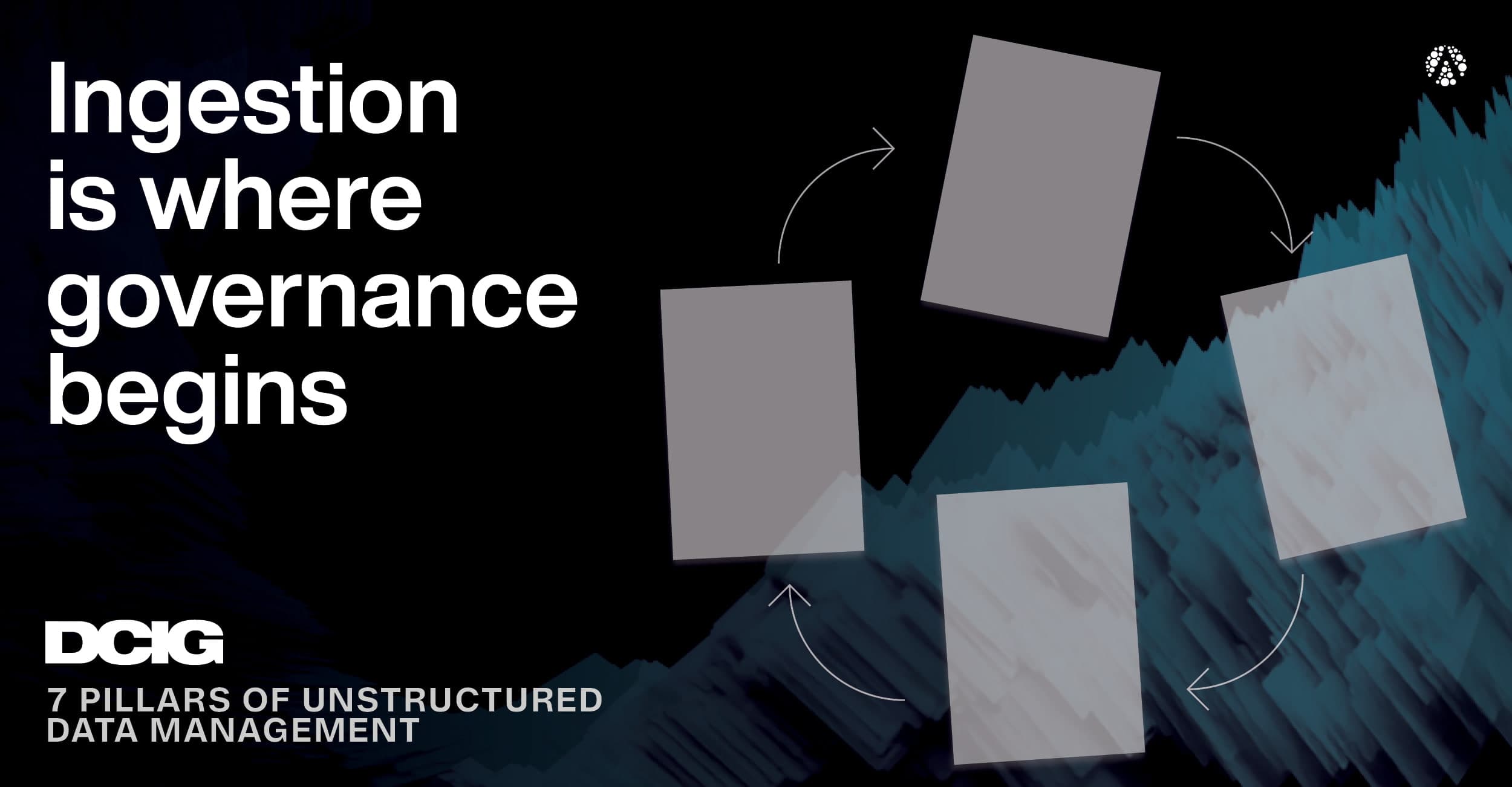
In the DCIG framework, ingestion is where governance begins, not where it is applied retroactively.
2) Storage optimisation and archiving
Data changes over time. Its value, access patterns, and regulatory obligations evolve.
Optimisation is not about cheaper storage; it is about appropriate placement throughout the lifecycle. Active data remains performant. Inactive data becomes economical. Archived data remains accessible and governed.
Without automation, optimisation collapses under its own weight. Manual tiering and ad-hoc archiving become sources of cost, risk, and inconsistency. This is why optimisation becomes architectural rather than operational once data volumes and lifespans increase.
The framework treats optimisation as a continuous process, not a migration project.
3) Data access and security
Unstructured data now represents the largest and least controlled attack surface in most organisations.
The challenge is not choosing between access and security. It is achieving both simultaneously.
Effective access control adapts to:
Identity and role
Data sensitivity
Location and context
Lifecycle stage
Security that obstructs work drives data into the shadows. Access without control invites risk. The balance must be systemic, not procedural.
4) Data preservation and resilience
Preservation is often reduced to backup. At scale, this is a dangerous simplification.
True preservation ensures data remains intact, usable, and trustworthy across failures, attacks, disasters, and decades of technological change. In large, long-lived data environments, the limits of traditional backup models become apparent very quickly. Recovery windows expand, protection gaps emerge, and operational overhead increases as data volumes grow.
The DCIG framework emphasises:
Continuous protection, not periodic snapshots
Rapid recovery at scale
Verifiable integrity
Long-term accessibility
These requirements reflect the realities of petabyte-scale environments, where discrete backups struggle to keep pace operationally and economically, and where resilience must be built into the data path rather than added after the fact.
What distinguishes mature unstructured data management is not excellence in any single capability, but integration across all four.
Data is ingested with context, optimised without losing meaning, accessed securely wherever it lives, and preserved continuously as it evolves.
These four pillars form the backbone of the DCIG framework and are explored in detail in the full report.
In the third blog of this series, we’ll look at where unstructured data management becomes truly strategic. That is, the contextual capabilities that separate baseline competence from long-term advantage.
Download the 7 Pillars of Unstructured Data Management report for the complete framework.