

Sometimes an image is worth much more than a thousand words, and two images like those below, so alike at first glance, can tell a multiverse of stories.
What’s in these two images? The first likely response is, ‘dinosaur bones in a museum display,’ or if you have a 5-year-old in your life, you probably thought ‘easy, that’s a Triceratops’. But if we scratch beneath the surface, there’s so much more to contemplate.
Each image is a story in itself:
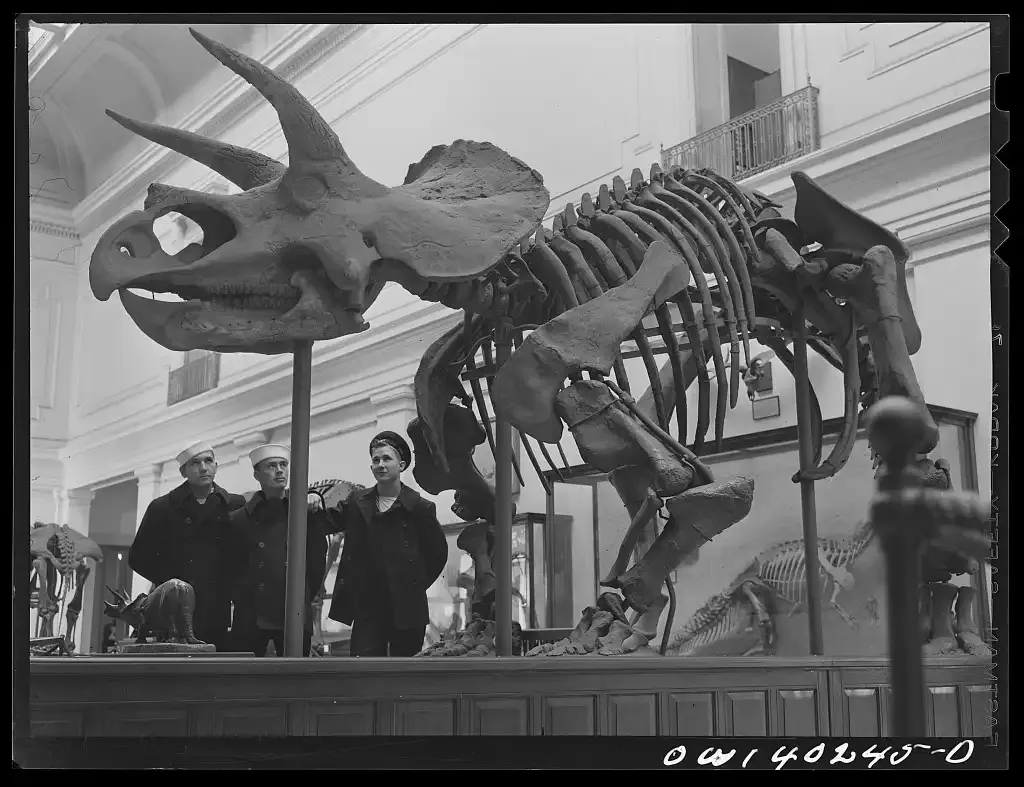
Sailors visit the Smithsonian Natural History Museum during WWII. Are they contemplating their own mortality, the traces of themselves they would leave behind, or warfare as a means of mass extinction? We’ll never know for sure, but the moment was captured on film. The negative then preserved by the U.S. Office of War Information. The collection’s custodianship was later transferred to the Library of Congress, where it was eventually digitised. It is now publicly available to download in multiple formats and resolutions.
That’s a rather extraordinary narrative when you think about all the people, places, processes (and probably paperwork) encapsulated in a single shot. But there’s more…
“Hatcher”, as the fossil dino they gaze upon was affectionately dubbed by the Smithsonian museum curators and staff after the palaeontologist who discovered him, was the world’s first Triceratops on display in 1905. Cobbled together from the bones of 10 different individuals as no complete Triceratops skeletons had been recovered at that time, he is an eclectic mashup of various Ceratopsid species, with a too small skull, legs of different lengths, and the wrong number of toes.
Hatcher is the ultimate poster child for preservation and presentation gone awry. After more than 90 years of awing visitors, the 67-million-year-old dino-pourri started to fall apart. Irreparable damage done by screwing metal rods directly into his skeleton was exacerbated by a nasty case of pyrite disease, brought on by exposing iron-sulphide minerals to humidity, causing the minerals to grow and fragment Hatcher’s bones from within. As with legacy storage systems marred by the ravages of bit-rot and physical degradation, Hatcher required a digital rescue mission to conserve his ravaged components.
Hatcher 2.0 was created from a complete 3D scan. His digital rebirth gave him the flexibility to have all his bits and pieces resized to fit and allowed the museum to produce a one-sixth scale model for display (how’s that for compression?!). Digitisation created opportunities for researchers and the public alike to guide the next chapters of his story and opened windows to the past.
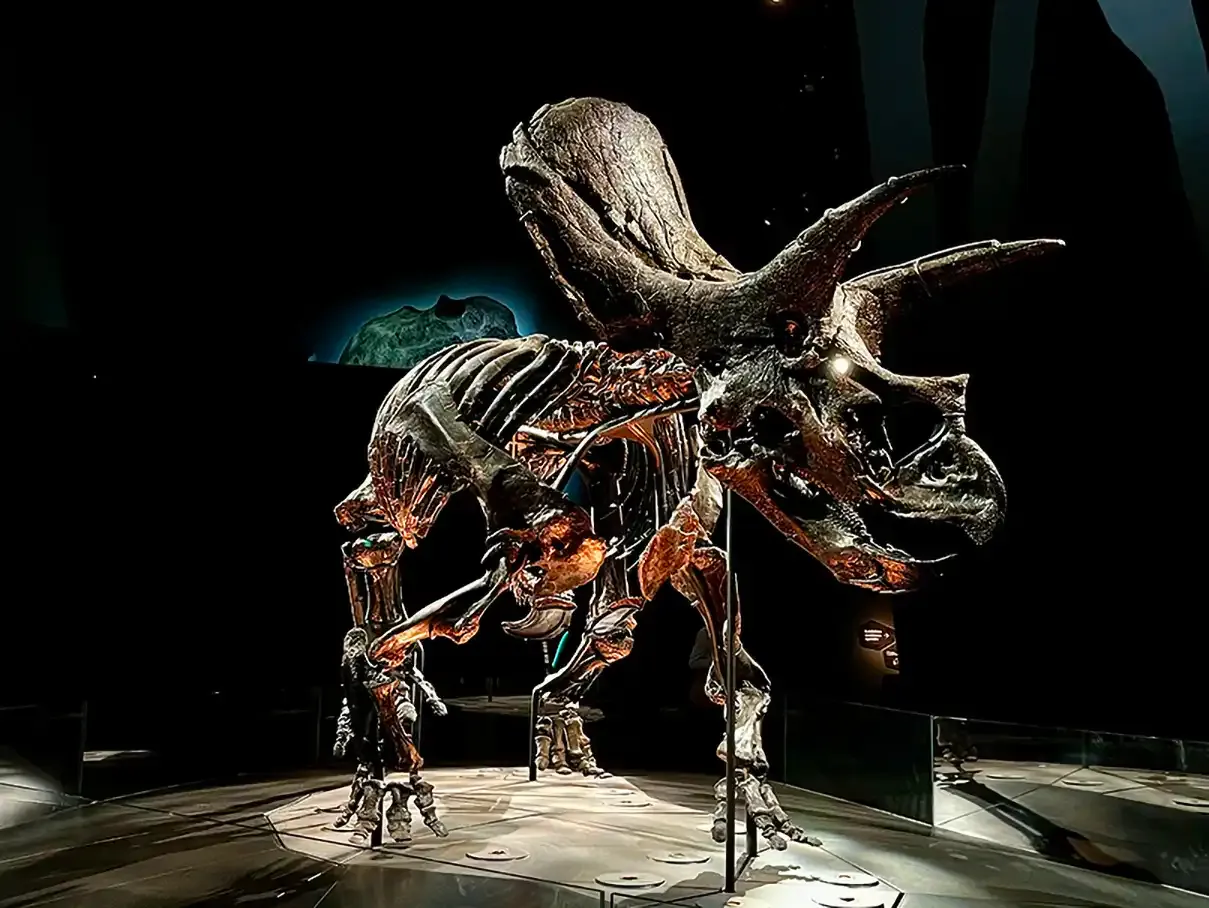
Contrast that image’s legacy with its born-digital counterpart, casually captured by a museum visitor on a mobile device then airdropped to her laptop. A recent acquisition by the Melbourne Museum, this Triceratops horridus is blissfully unaware of the looming spectre of its demise — the cleverly placed meteorite display, detailing the timeline of the day the dinosaurs died, glowing ominously in the background. Scientific storytelling built into the very atmosphere.
One of the most complete Triceratops fossils ever unearthed, Horridus is an immaculately preserved specimen. Painstakingly excavated from his final resting place in Montana before being packed into seven large crates for transport to Australia from Victoria, Canada, he’s essentially a Mesozoic TCP transfer. Upon arrival in Melbourne, each bone was measured, labelled and 3D scanned prior to display, analogous to performing checksums to assure the complete and correct global data transmissions. The digitised fossil is now available to researchers around the world, guiding new insights into this iconic creature.
The distinct narrative arcs of these two Triceratops specimens mirror the evolution of digital preservation and exhibition. Not only have the technologies improved, but the curation approach from the first point of contact through to public engagement has matured significantly. The next volume in this series invites collaboration and co-creation of the GLAMS experiences the public and external researchers desire, with collections accessible, accession-able, and tailor-able to every individual’s interests.
Forward-thinking institutions are exploring and experimenting with the next wave of digital asset management systems, that enable scalable, sustainable experience creation and facilitate collaboration and research. Start a conversation with us today to understand how the Mediaflux DAMS can breathe new life into old stories.
Head to the DAMS for Cultural Collections page to see how Arcitecta is reimagining the way cultural organisations manage their data or download our DAMS for GLAMS white papers to dig a little deeper…